

Product selection
Choosing a cable family by application
A safer technical workflow starts from application, cable construction, standard, and document need before opening the catalogue.
- Cable selection
- Application
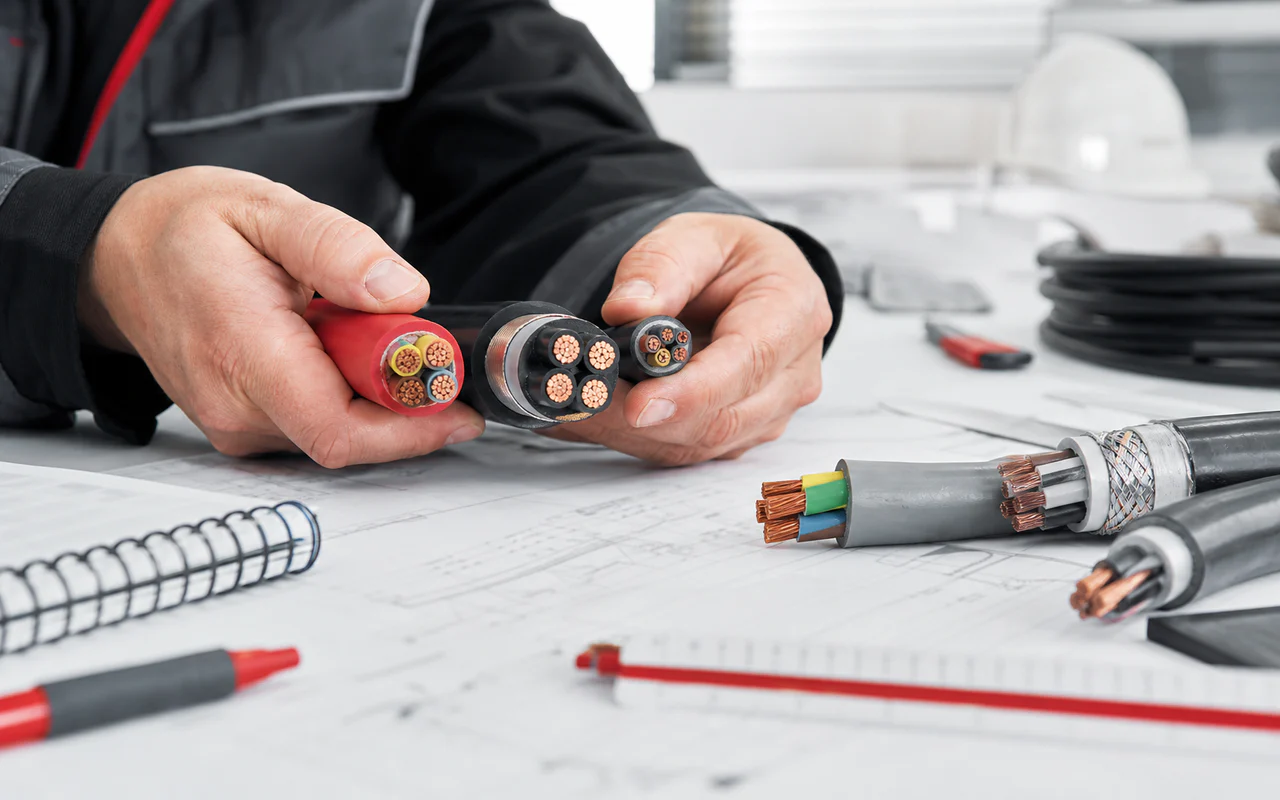
Start with the application
Cable selection should not begin with a catalogue heading. First define the electrical system, whether the cable will be fixed or flexing, whether it will be installed indoors or outdoors, and which safety or document requirements the project imposes. Building installation, control panels, solar PV connections, EV charging and flexible connections do not lead to the same cable family. A precise application brief lets the technical team open the right product group and gives procurement a basis for comparable quotations.
A request that says only “cable price” leaves the supplier to fill in the gaps. Include system voltage, installation method, expected movement, environmental exposure, required cross-section range and core count where those details are known. When a value is not yet confirmed, mark it as open. Missing information should be requested, not replaced with an invented assumption.
Narrow the family by construction and environment
Family selection follows the cable’s construction and the conditions it will face. Check conductor material and class, core arrangement, insulation, sheath, flexibility and screening at product-code level. PVC and HFFR are not interchangeable material descriptions. LSZH refers to low-smoke, halogen-free behaviour; HFFR describes a halogen-free flame-retardant compound approach. Neither term proves a performance characteristic that the source does not state.
Do not use flame-retardant and fire-resistant as synonyms. A flame-retardant requirement may concern limiting flame spread, while a fire-resistant requirement may require circuit integrity for a specified period. Outdoor use, UV exposure, oil, chemicals, temperature or continuous flexing also cannot be inferred from a product name alone. Match each condition separately to the project specification and the technical table.
Read the product code with the technical table
A cable family is only the first filter. Before ordering, review the product code, cross-section, core count, conductor construction, insulation and sheath details, rated values and the technical table on the product page. Several construction options may exist within one family. A general catalogue description does not define every limit of a specific code, so the quotation and approval record should name the product code rather than the family alone.
If a value is missing from the technical table, do not carry it over from a similar code. “Approximately”, “equivalent” or “normally” is not an engineering approval. When comparing suppliers, confirm that each quotation covers the same headings: cross-section, core count, construction, applicable standard, test or document scope and, where relevant, installation conditions. This compares offers against the same technical requirement, not just against price.
Connect the standard to the product code
A standard reference on its own is not proof of suitability. Check the complete reference required by the project, the cable construction to which it applies and how it is shown in the product record. A standard listed for one product code does not automatically apply to another. Solar PV cable records may refer to standards such as EN 50618:2014 or IEC 62930:2017; the final decision still belongs to the relevant product record and current document.
If the project requires CPR, a DoP or a specific certificate, write that requirement beside the standard and ask for the scope to be matched to the product. CPR is a regulatory conformity framework; not every fire-related statement is a CPR class. A DoP is a declaration for stated performance. If the source does not show the class, date, scope or product code clearly, treat the point as open rather than complete.
Verify the document by scope, not filename
A data sheet, certificate, DoP, catalogue and test report do different jobs. A data sheet describes construction and the technical information provided; a certificate or DoP may establish a defined conformity or declared-performance scope; a catalogue provides family-level navigation. State the required document type in the quotation request. When you open the file, check the product name, product code, standard, scope, validity information and, where relevant, the issuing body.
Do not attach a document to a different product because the filename looks similar. If the relationship to the product family or code is unclear, ask the technical team to confirm it and keep the uncertain match out of the approval pack. For documents with revision or date information, also establish which version is current. Procurement, quality and project teams should work from the same product code and the same document set.
Check conductor size against current rating and voltage drop
Once the family and product code are fixed, do not size the conductor on load current alone. The current a conductor can carry depends on ambient temperature, how many circuits share the same conduit or tray, and the installation method. After the correction factors of IEC 60364-5-52 are applied, a cross-section that looks sufficient in the catalogue can fall short on site — bunched flexible conductors such as H05V-K or H07V-K inside a panel lose a significant share of their free-air rating. On long feeders, voltage drop becomes the limiting factor before current rating does, and the cross-section must be stepped up accordingly. Check the minimum bending radius, permitted pulling force and lowest installation temperature from the technical table as well: PVC insulation stiffens in the cold, and a reel installed straight from cold storage can crack. Running these checks before the order is placed avoids re-sizing and repeat purchasing on site.
Send an RFQ with information that can be checked
A useful RFQ reduces the points the supplier must guess. Put the application, product family or known product code, cross-section, core count, conductor and construction expectations, standard, required document type, quantity and delivery context in one list. Mark an item as “to be confirmed” when it is not final. That is safer than silently selecting a default and lets the technical team return with the right question.
Keep four records together for the final review: the specification, product page, technical table and document. If all four identify the same product code and requirement, the purchasing decision becomes traceable. When application, standard or document scope conflicts, stop before comparing prices. Final suitability rests on the product code and documented technical evidence, not on the family name alone.