

Product selection
How to compare NHXMH, N2XH and 6181B cable
Compare NHXMH, N2XH and 6181B in CMK's HFFR installation range by construction, application, product code, standard, technical table and document scope.
Products
Products and families referenced
Start with the installation family
NHXMH, N2XH and 6181B appear in CMK’s HFFR installation cable range, but that shared family does not make them the same cable. Start with the system requirement: fixed building wiring, a populated public area, a single-core distribution arrangement, or a multicore power circuit. State application, installation method, voltage, quantity and required documents in the RFQ. This gives the manufacturer or supplier enough information to review the right product code instead of pricing a similar reference.
Do not use HFFR or LSZH as a stand-alone acceptance criterion. The source records describe NHXMH and N2XH with XLPE insulation, HFFR filler and HFFR sheath. The 6181B record describes XLPE insulation and an LSZH sheath with Class 1 solid or Class 2 rigid copper. These are construction descriptions, not permission to substitute one product for another. The project specification and product-level technical sheet remain decisive.
Read the NHXMH and N2XH construction at code level
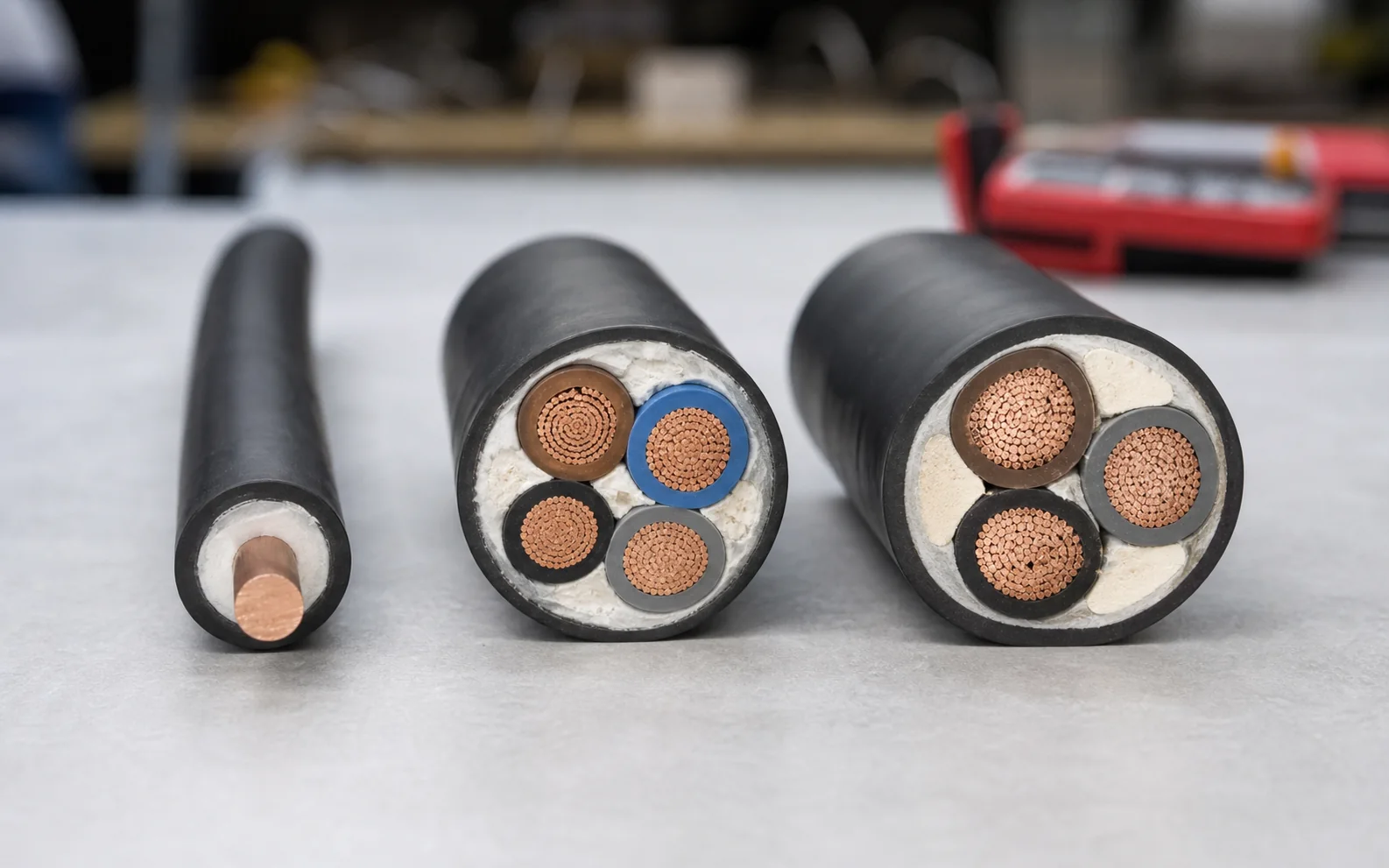
The source records give NHXMH and N2XH the same broad construction pattern: Class 1 solid or Class 2 rigid copper conductor, XLPE insulation, HFFR filler and HFFR sheath. That similarity still does not make the two product codes interchangeable. NHXMH is recorded against TSEK 328:2015 and VDE 250, while N2XH is recorded against TS HD 604 S1 5G. The standard reference, conductor arrangement, available cross-sections and approval documents must be reviewed together.
Their technical tables are also separate. At 1x1.5 mm², the NHXMH table shows 0.5 mm insulation thickness, 5.5 mm average overall diameter and approximately 42 kg/km. The N2XH row shows 0.7 mm, 5.7 mm and 44 kg/km. Those are not catalogue details to ignore; they may affect termination, stripping, tray capacity and installation planning. Put the exact cable code and cross-section on the request for quotation.
Keep 6181B separate from multicore references
The 6181B record is different again. It is listed as a single-core product, with a technical table covering 1x1 mm² to 1x35 mm². Its construction is Class 1 solid or Class 2 rigid copper, XLPE insulation and LSZH sheath. The application note points to areas with high occupancy where fire and toxic smoke are a concern. That helps define where the product may be reviewed; it does not state that 6181B replaces NHXMH or N2XH.
For 6181B at 1x1.5 mm², the source table gives 0.7 mm insulation thickness, 0.8 mm sheath thickness, 4.7 mm average diameter and approximately 34 kg/km. It should not be compared directly with a multicore cable only because the nominal cross-section is the same. Core count, sheath arrangement, standard and circuit design are different. For a 6181B selection, confirm phase, neutral and protective-conductor arrangement, installation method and the project standard separately.
Check application, cross-section and installation conditions
Cable selection is more than finding a familiar product code. NHXMH and N2XH tables include options from single-core to five-core constructions, while the 6181B table is single-core. Establish the required core arrangement before comparing price or dimensions. Then confirm how the cable will be installed in a tray, conduit, trunking or another fixed route. Heat dissipation, grouping and conductor sizing can change with the installation method, so the technical table is evidence for the selection, not a replacement for the site calculation.
Review load current, voltage drop, ambient temperature, the number of circuits on the same route, compatible terminations and mechanical limits. Do not import an ampacity or bending value from a nearby product when the source does not show it for the requested code. Give the manufacturer the code, cross-section, core count, quantity, delivery context and requested data sheet or technical sheet. Mark an open value as to be confirmed instead of silently using a default reference.
Match the standard and document scope
A standard name by itself is not proof of suitability. The source record lists TSEK 328:2015 and VDE 250 for NHXMH, TS HD 604 S1 5G for N2XH, and BS EN 7211:2012+A1:2020 for 6181B. Read each reference with its product code and technical record. If the project calls for an EN, BS EN, TS HD, TSEK or VDE reference, copy the full requirement beside the code in the RFQ and ask the supplier to state the supporting record.
NHXMH lists TSE-HAR, DATA SHEET, CPR (CE) and CE; N2XH lists TSE-HAR, DATA SHEET and CPR (CE); 6181B lists BASEC, DATA SHEET, CPR (CE), CPR (UKCA) and CE. A list does not prove that every document covers every cross-section or installation condition. A certificate, data sheet, DoP and company quality certificate provide different evidence. Check code, revision, standard and scope before adding a file to the approval pack.
Compare price only after technical matching
A search for “NHXMH cable price”, “N2XH cable price” or “6181B cable price” is useful for finding suppliers, but it is not a purchasing specification. When requesting a quote, include cable code, cross-section, core arrangement, packing or drum expectation, quantity, delivery location and the required certificate/documents package. Two offers are not commercially comparable when they show different codes, standards or document scopes, even if the wording and nominal cross-section look similar.
A lower price before technical approval can lead to site resizing, document replacement or delayed acceptance. Use separate RFQ fields for product code, construction, cross-section, standard, document type, quantity, lead time and price. When an offer says “equivalent”, ask which product, test and document establish that comparison. A clear quote request to CMK lets the technical and sales teams return against the correct record.
Close the selection with four matching records
For final approval, the product page, technical table, requested certificate or data sheet and project specification should identify the same product code. NHXMH, N2XH and 6181B may sit under the same HFFR installation family, but that classification does not merge their standard, core arrangement, sheath type or document scope. If a document name and product code do not agree, keep it out of the approval pack and request written scope confirmation from CMK.
Write the code in full on the order: NHXMH, N2XH or 6181B, with cross-section and core arrangement where applicable. At goods receipt, compare the drum label, code, cross-section, batch number and DoP or certificate. An open question is safer than an unsupported substitution claim. The correct choice follows a verified chain of construction, application, standard, technical table and documents, not a shared family heading.