Product selection
Selecting H05V-K / H07V-K (NYAF) wire for panels and installations
For H05V-K and H07V-K (NYAF), confirm flexibility, cross-section, installation context, technical table and document scope together.
Products
Products and families referenced
Match the product code to the installation
H05V-K / H07V-K (NYAF) is listed in the CMK record under single-insulated PVC installation cables. Its construction is stated as a Class 5 flexible copper conductor with PVC insulation. That explains its relevance to panel wiring and installation work, but it is not an automatic approval for every project. Start by checking that the intended use matches the record: inside buildings, in dry locations, in conduit, or in connection and distribution installations below or above plaster.
Do not describe the requirement only as “NYAF wire” in an RFQ. Panel wiring, a connection to a moving appliance and fixed building wiring are different contexts. State the circuit, expected movement, whether the route is dry, and whether the conductor will be in conduit or exposed. Do not infer outdoor, oil, chemical, UV or continuous-flexing performance that the source does not state. Keep the product code, application and required documents together in the request.
Read the H05V-K and H07V-K split in the table
The CMK technical table gives the two codes separate voltage entries in the same product record. H05V-K is shown as 300/500V, with 0.5 mm², 0.75 mm² and 1 mm² listed. H07V-K is shown as 450/750V, with listed sizes from 1.5 mm² to 120 mm². Do not transfer one code’s voltage entry to the other. The quotation and approval record should state the code and cross-section together.
The table includes insulation thickness, average outside diameter, resistance and approximate weight. For example, 1 mm² H05V-K is listed at 0.6 mm insulation, 2.4 mm average diameter, 19.5 Ω/km resistance and 14 kg/km approximate weight. For 2.5 mm² H07V-K, the entries are 0.8 mm, 3.6 mm, 7.98 Ω/km and 30 kg/km. These values support procurement comparison, but they do not replace current-carrying calculations. Installation method and grouping still require technical review.
Use flexibility correctly inside a panel
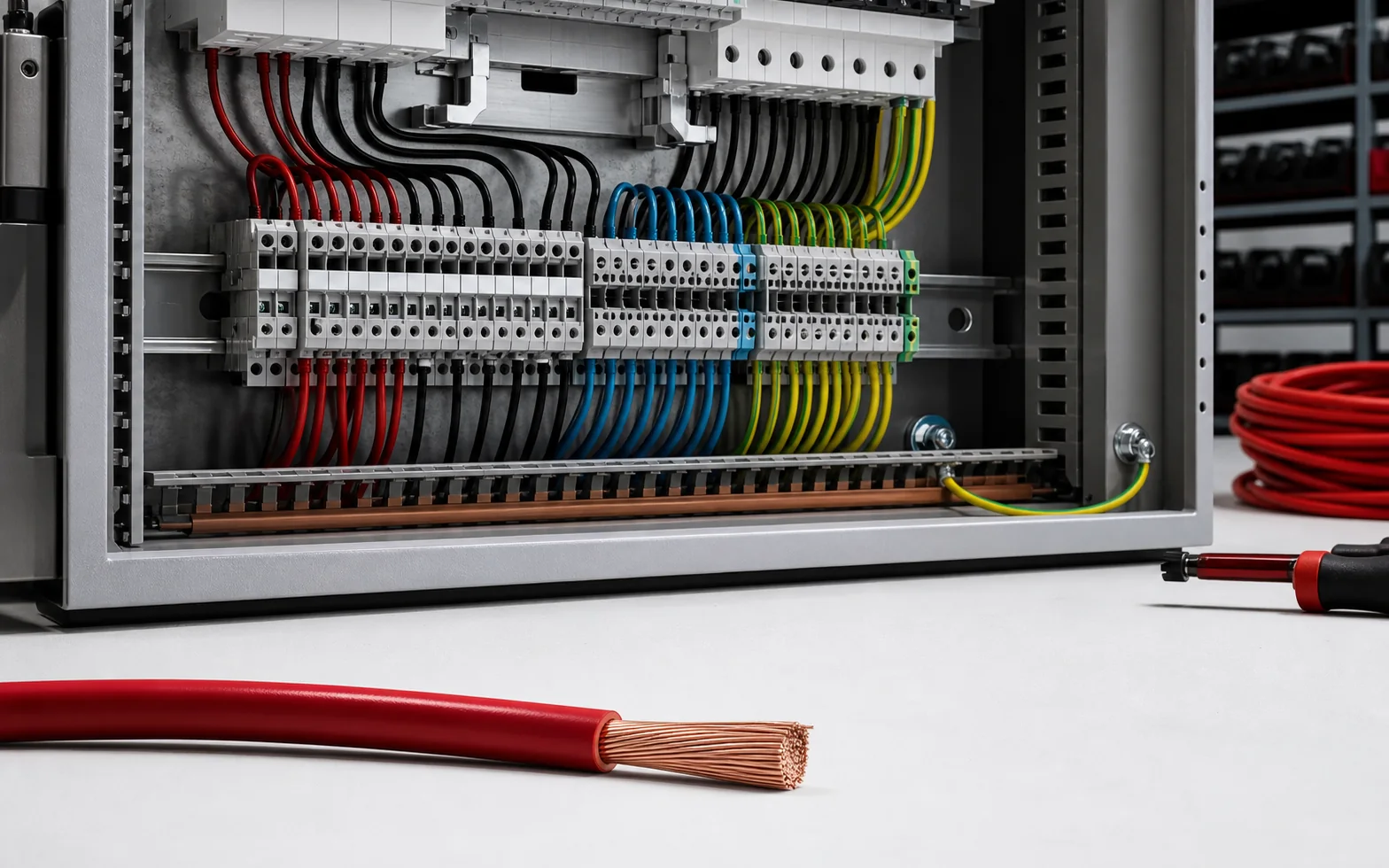
A Class 5 flexible copper conductor can be routed through confined panel spaces more easily than a rigid single-core option. For a panel builder, that helps organise wiring between terminals, devices and wiring ducts. “Flexible” does not mean unlimited bending or continuous movement. Turns, fixing, termination preparation and the equipment terminal instructions must be checked against the available data sheet and the actual assembly design.
The product record names connections to moving appliances as an application, but that does not remove the need to assess the movement itself. Repeated flexing, vibration, pulling, sharp edges or a tight bend should be referred to the supplier where the technical limits are not stated. Do not select the cross-section only because it fits a terminal. Consider circuit load, termination arrangement, conductor density and installation conditions so the NYAF choice is based on a defined application rather than convenience alone.
Carry size and dimensions into the quotation review
The technical table gives a consistent basis for comparing physical and electrical values across sizes. For H07V-K, 1.5 mm² is listed with 0.7 mm insulation, 2.9 mm average outside diameter, 13.3 Ω/km resistance and 20 kg/km approximate weight. For 10 mm², the entries are 1 mm, 6.3 mm, 1.91 Ω/km and 118 kg/km. Such differences matter to duct fill, terminal selection, reel planning and logistics.
Do not treat catalogue dimensions as the complete project calculation. Current rating, voltage drop and terminal capacity must be verified against load, circuit length and installation method. Put code, cross-section, quantity and delivery format in the RFQ. A general search for “H07V-K cable price” can mix sizes in one result. The supplier’s price or quote should clearly relate to the same code and cross-section under review.
Verify the technical table against document scope
The product record lists TSE-HAR, DATA SHEET, CPR (CE) and CE entries in its certificates area. These entries are a starting point for document discovery; a file should not be accepted for every size, code or use merely because its name looks similar. Before adding a data sheet or technical sheet to a purchasing file, check the product name, code, construction and stated scope.
The product record does not provide a populated standard field, so do not add an IEC, EN or VDE reference that is not visible in the source being used. If the project requires a named standard, certificate or conformity document, send that requirement to the manufacturer as a question. A file found through the Documents page must be matched to H05V-K / H07V-K and the requested size. Treat unclear scope as open and request technical confirmation.
Close the RFQ and purchase decision
A useful RFQ brings together the product code, the H05V-K or H07V-K selection, cross-section, quantity, application, panel or installation context and the required certificate/documents set. If needed, state whether a data sheet, technical sheet, TSE-HAR record or CPR/CE-related document is required and ask for its scope. Include delivery location and timing. This lets the manufacturer or supplier answer open points instead of filling them with assumptions.
When comparing offers, check the technical match before the price or quote. A lower price is not a meaningful advantage when code, cross-section, voltage entry or document scope differs. Keep the product page, technical table, matched document and project specification together for approval. This gives the panel builder and end user a traceable basis for selecting the same NYAF wire and avoids ordering from an undefined family name.