Product selection
NYY power cable selection: a procurement review guide
Review the NYY product code, PVC construction, application limits, technical table, TS IEC 60502-1 reference, documents and RFQ inputs in one controlled workflow.
Products
Products and families referenced
Fix the NYY code and product family first
A quotation review does not end when the name NYY appears. First record that the requested product is genuinely coded NYY and that the enquiry belongs to the PVC installation cable family. The source product record identifies the code as NYY. That distinction keeps 6181Y or Flat Twin & Earth, which sit in the same family but serve different purposes, out of an incorrect comparison. State the product code, requested sizes and intended use together when asking a manufacturer or supplier for price.
An RFQ that says only “NYY cable price” leaves the quotation basis unclear. Include the product code, core arrangement or cross-section, quantity, whether the line is for power, mains or lighting, and the required document type. If an earlier order gives a product code, quote it as a reference. If the code is not known, ask the supplier to identify the missing technical inputs instead of allowing a default construction to be assumed.
Verify construction against the product record
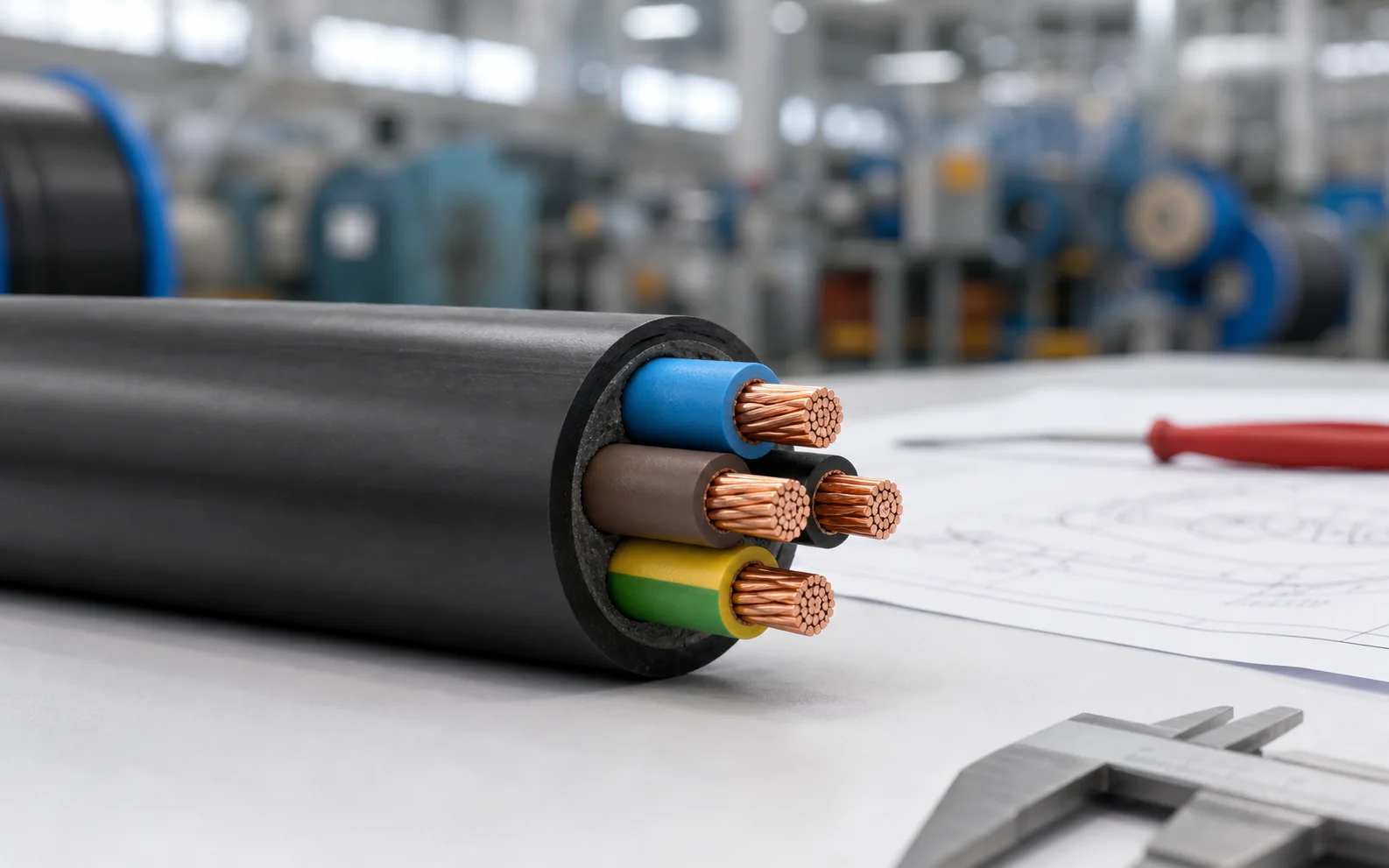
The repo-verified NYY construction uses Class 1 solid or Class 2 rigid copper conductors. The insulation is PVC, the filler is PVC and the outer sheath is PVC. This means that “copper cable” is not enough for procurement approval; conductor class and each material layer must be checked at product level. The data sheet construction should match the code quoted, with no silent substitution of a different conductor class or sheath description.
Construction is also the starting point for application review. The NYY record does not state a screen, armour, flexible Class 5 conductor or halogen-free sheath, so none of those features should be inferred. If the project specification asks for them, do not treat NYY as automatically equivalent. Ask the manufacturer for written technical confirmation or review another product family. Keep missing information as an open question rather than filling it with an assumption.
Put the application and mechanical limit in writing
The source record describes NYY as a power, mains and lighting cable used in outdoor cable ducts and underground where there is no risk of mechanical damage. That places the product in the context of fixed energy routes. In the RFQ, state whether the route is an outdoor duct or an underground line and explain how the project has assessed mechanical-damage risk. A clear application sentence gives the supplier a usable basis for technical confirmation.
“Suitable underground” should not be expanded into “suitable for every ground condition or mechanical exposure.” The verified wording expressly limits the use case to locations without mechanical-damage risk. Where the route faces impact, crushing, heavy traffic, excavation risk or a need for additional protection, resolve the matter with the project engineer and supplier before quotation. For NYY, the application statement is a more useful RFQ input than the product name alone.
Read the technical table at code and size level
The NYY technical table lists cross-section, insulation thickness, outer-sheath thickness, approximate outer diameter, resistance, approximate weight, current-carrying capacity in ground and current-carrying capacity in air. For example, the 3x2.5 row gives 0.8 mm insulation, 1.8 mm sheath, 12.5 mm approximate diameter, 7.41 ohm/km resistance, 240 kg/km approximate weight, 34 A in ground and 25 A in air.
Those values belong to that row and must not be transferred to another core arrangement or cross-section. The 1x4 row shows 4.61 ohm/km, 44 A in ground and 34 A in air, while 4x16 shows 1.15 ohm/km, 98 A and 80 A. Preserve the exact code, unit and source row in the comparison sheet. Treat the table as product-specific evidence, not as a family-wide average.
Check TS IEC 60502-1 together with document scope
The NYY product record gives TS IEC 60502-1 in its standard field. Read that reference with the product code and technical scope; do not replace it with a general IEC statement copied from another cable. The document centre lists TSE - HAR, DATA SHEET, CPR (CE), CPR(UKCA) and CE records for NYY. Record the role of each document separately so a data sheet is not treated as a certificate or a regulatory declaration.
For each file, compare the product name, document type, any DoP number and the stated NYY scope. The TSE - HAR record is named for NYY and TS IEC 60502-1. The CPR (CE) record is listed as IEC 60502-1 NYY with DoP CMK-DOP-013, while the CPR(UKCA) record carries NYY and CMK-UKCA-018. Use the document text and scope, not the filename alone, for approval.
Make the RFQ and price comparison technically comparable
An NYY RFQ should state the product code, each cross-section, core count, required length, application, delivery-unit expectation and document package. Ask for a data sheet or technical sheet separately from a certificate. When requesting a price or quote from a manufacturer or supplier, confirm that the offered code is NYY and that every table value quoted belongs to the requested size and construction.
Price does not create comparability by itself. If one offer is for 3x2.5 NYY and another is for a different core arrangement or product family, the totals cannot be reviewed as equivalent. Before approval, check product code, construction, size, application, TS IEC 60502-1 reference and document scope on one review form. Any unresolved point should become a technical question before it becomes a purchase commitment.
أغلق سجل التحقق قبل إصدار الطلب
At final approval, the technical and commercial records must refer to the same product. The NYY code, cross-section and core count on the quotation must match the product record; the application must be described as an outdoor cable duct or an underground route without mechanical-damage risk; the technical values must come from the correct table row; and the TS IEC 60502-1 reference must remain visible in the file. This check fixes the identity of the purchased product, not only its price.
Link the document package to the same record. State clearly which of the DATA SHEET, TSE - HAR, CPR (CE), CPR(UKCA) and CE documents the project requires, then compare the scope of each document with the NYY code. In the final supplier confirmation, repeat the product code, quantity, delivery details and required documents. This keeps the manufacturer, distributor and procurement team aligned on one technical description.