
Product selection
Reviewing YY PVC and YY LSZH control cables
For YY PVC and YY LSZH, the material name alone is not a selection decision; check the relevant technical table and document record.
- YY PVC
- YY LSZH
Products
Products and families referenced
Do not draw conclusions from the sheath name alone
In CMK records, YY PVC and YY LSZH are listed as separate control-cable products. The presence of PVC or LSZH in the product name is only one part of the construction information and does not, by itself, describe the complete product. Treating the name as a full technical specification during procurement or engineering review can lead to assumptions that the record itself does not support.
Environmental resistance, fire performance, or a specific application condition should never be inferred from the sheath material name alone; these characteristics must be confirmed from the technical table when stated. The reliable approach is to decide at product level, referencing the documented data rather than the naming convention, particularly when a specification or quotation depends on a precise technical match.
Match the document record to the correct product
When a data sheet, certificate, or Declaration of Performance is required, the file name and scope must be confirmed against YY PVC or YY LSZH specifically, not against the general product family. A similar-sounding file name is not proof that the document applies to the product under review; each file needs to be checked against its stated product code.
Skipping this confirmation step can cause technical review and quotation activity to reference two different products without either party noticing. Verifying that the document and the product code correspond exactly keeps the commercial and technical conversation aligned on the same item throughout the sourcing process.
What the "YY" construction designation communicates
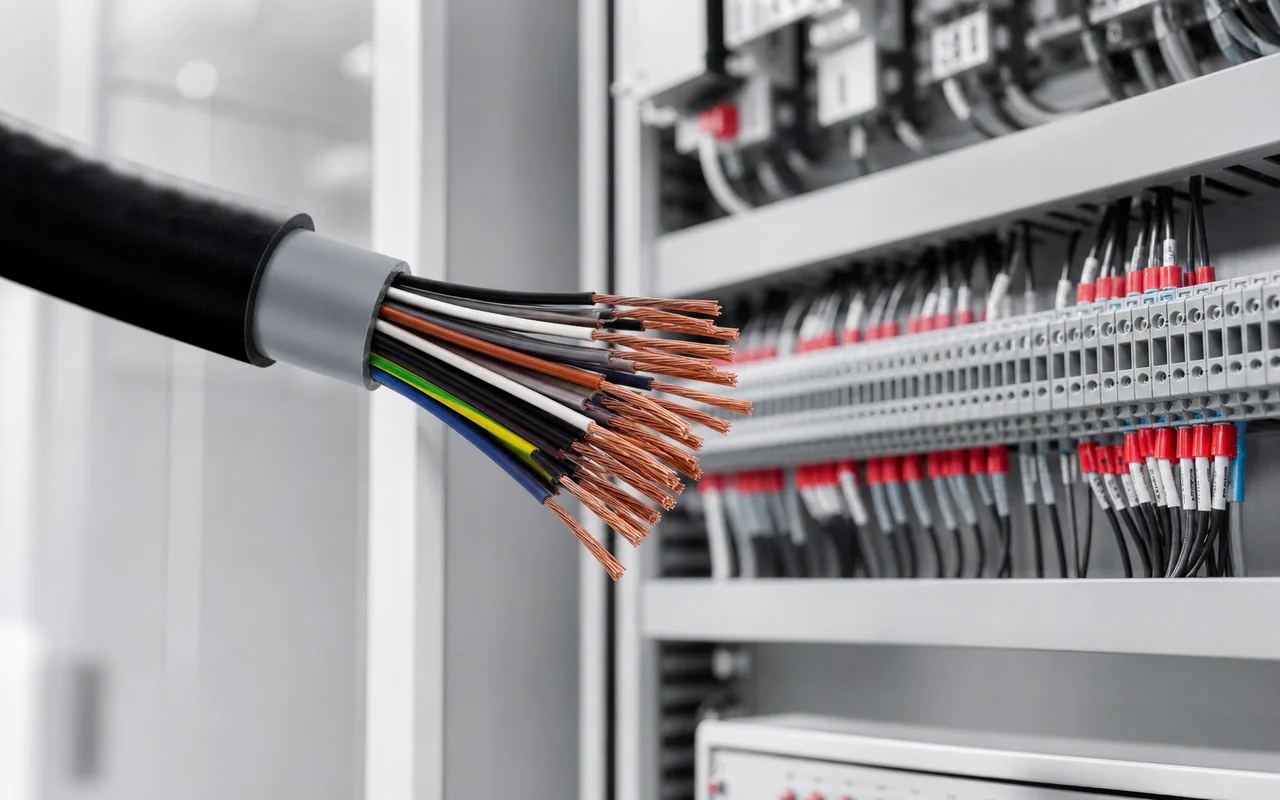
The "YY" designation used for control cables generally describes a flexible, multicore arrangement typically applied in control and signal wiring for panels and machinery. This designation gives a general indication of the cable's mechanical construction and intended field of use within control wiring applications.
On its own, however, it does not communicate fire performance, smoke behavior, or a specific environmental rating. Those characteristics depend on the sheath material and must be read together with the technical table rather than assumed from the construction code alone; treating the designation as a complete performance statement risks an incomplete technical picture.
Confirming parameters in automation and panel-building projects
Control-cable requirements in automation and panel-building projects are typically expressed through core count and cross-sectional area as the primary technical parameters. These values define the basic sizing of the cable but are not sufficient on their own to identify a specific product.
The same core count and cross-section can apply across different product codes, so the requirement should be confirmed at the level of YY PVC or YY LSZH specifically rather than left as a general "control cable" request. Leaving this unconfirmed increases the risk of comparing quotations against the wrong product or discovering a mismatch during installation.
Avoiding the LSZH-to-fire-classification assumption
A common mismatch risk is assuming that an LSZH sheath automatically carries a specific flame-retardant or fire-resistant classification. LSZH describes a construction property related to smoke density and halogen content, which is a distinct characteristic from a flame-retardant claim of limited flame spread or a fire-resistant claim of circuit integrity during fire.
Any such classification for YY LSZH must be confirmed from the actual technical record rather than inferred from the sheath descriptor. Carrying this assumption into a specification or purchase order can result in a product being selected that does not meet the intended technical requirement.
Compare two offers at code level
Two quotations can both say control cable and still be for different products. Before comparing prices, put both on the same basis: the same product code, the same core count and cross-section, the same sheath material, and the same technical table. A price gap that looks commercial often turns out to be a construction difference once the codes are set side by side.
Record which code the comparison was made on, not only the price that won it. When the order is repeated months later, the code is what makes the second order identical to the first. The control cable we bought last time is not a reference that survives a change of staff on either side.
Conclusion
YY PVC and YY LSZH should be treated as distinct, code-level decisions, each confirmed through the technical table and the matching document rather than through assumptions drawn from the sheath name. This discipline keeps technical review, quotation, and procurement consistently aligned on the same product.