Product selection
TRI-RATED Cable for Panel Builders: Construction, Technical Data and RFQ Checks
A practical review path for TRI-RATED cable in panel wiring: confirm construction, read the technical table, match standards and documents, then issue a comparable RFQ.
Products
Products and families referenced
Tie the product code to the panel application
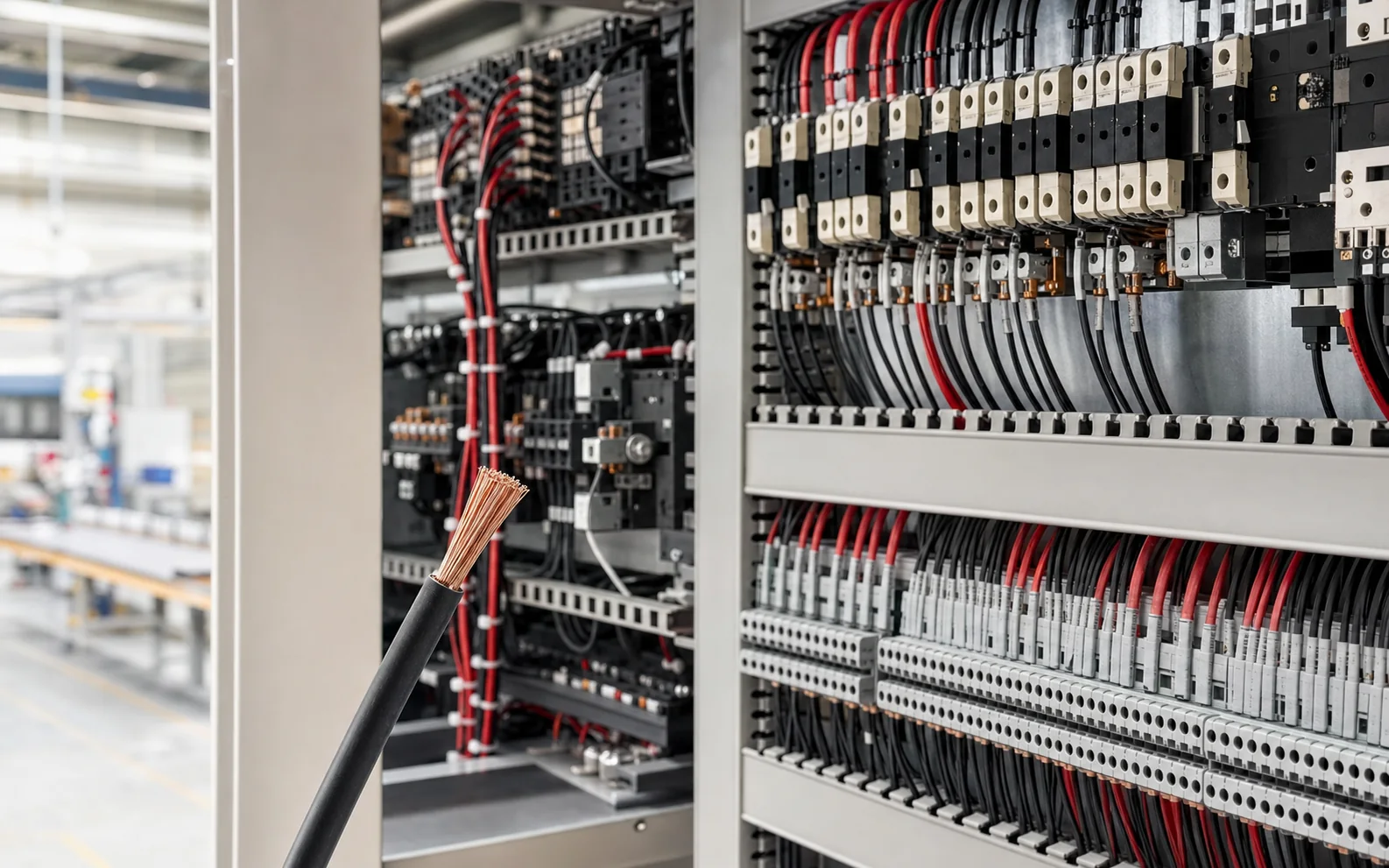
For a panel builder, the first check is not a general cable search but the function of the connection inside the panel. The CMK product record uses the TRI-RATED code for a heat-resistant, flame-retardant cable intended for internal connections in power switchgear control, relay and instrumentation panels, rectifier equipment, motor starters and controllers. That scope does not automatically make the product a general outdoor feeder or a substitute for every installation cable. The purchasing brief should state the panel function and the equipment in which the connection will operate.
A quotation request that says only “TRI-RATED cable price” leaves material technical assumptions open. Send the product code, application, required cross-section, core count and document type together. If the project has not fixed a cross-section, mark it as an open confirmation item instead of asking the supplier to guess. The supplier can respond to the requirement.
Verify construction from the source record
The original product record gives two core construction facts: a Class 5 flexible copper conductor and PVC insulation. Class 5 identifies the flexible conductor class; it does not authorize adding a different conductor class, screen or sheath that the record does not state. PVC insulation is likewise an explicit construction detail. For panel design, review cross-section, duct layout, termination points and identification together with these construction facts. If a supplier data sheet shows a different construction, confirm that the explanation belongs to the same TRI-RATED product code before approval.
Do not complete the TRI-RATED designation with technical values taken from another cable. Calling a cable heat-resistant or flame-retardant does not prove rated voltage, current-carrying capacity, bending radius or installation temperature when those values are not in the source record. Ask the manufacturer or authorised supplier for a product-code-specific answer where the project requires it. Keeping the product code, construction, technical table and document record in the approval file makes later equivalence claims easier to test.
Turn the technical table into order inputs
The TRI-RATED technical table gives cross-section, insulation thickness, average outer diameter, resistance and approximate mass as linked fields. The listed range starts at 0.50 mm² (20 AWG) and runs to 240 mm² (500 AWG). The record shows average outer diameters of 2.4 and 2.6 mm for 0.50 and 0.75 mm², 2.7 and 3.0 mm for 1 and 1.5 mm², and 3.4 and 3.9 mm for 2.5 and 4 mm². These are source values for checking panel duct fill and terminal compatibility.
Read the same fields for larger conductors rather than selecting by area alone. For 6 mm², the record gives 1.14 mm insulation thickness, 4.4 mm average diameter, 3.3 Ω/km resistance and approximately 68 kg/km. For 10 mm² it gives 1.52 mm, 5.7 mm, 1.91 Ω/km and 121 kg/km; for 16 mm², 1.52 mm, 6.7 mm, 1.21 Ω/km and 199 kg/km. From 25 to 240 mm², follow the listed diameter, resistance and mass values when checking ducts, lugs, bending space and handling. Do not replace a missing table value with a value from a similar code.
Separate the standard record from the document record
The original TRI-RATED product page lists BS EN 50525-2-31:2011 in its standard field. Treat that as the standard reference attached to this product record, not as automatic evidence for another code or construction. Put the reference beside the product code in the RFQ and ask the supplier to show the same match in the technical sheet. A standard name is not by itself a certificate, declaration of performance or proof of a project-specific performance class. When the specification asks for an additional standard or document, confirm its relationship with the TRI-RATED record separately.
The repo document records include a TRI-RATED DATA SHEET, a BASEC record, a CPR(UKCA) record and a CE record. The CPR(UKCA) entry is named “Tri Rated (BS 6231)” and carries DoP number CMK-UKCA-016; the CE entry is listed as “TRI-RATED - CE”. Review these records by scope, not filename. Check product name, product code, standard, scope, date or validity information and, where relevant, issuing body. A request for “certificate/documents” is too broad for approval; state which data sheet, declaration or certificate is required.
Check the panel use against technical limits
The TRI-RATED record defines internal connection applications, but the application label alone does not select a conductor size for a particular panel. The design team must assess nominal current, connection length, internal routing, grouping and terminal arrangement under its applicable design rules. The resistance value in the technical table is a source input for the conductor and circuit review; an ampacity value absent from the record must not be copied from a similar cable. Likewise, average outer diameter helps check duct and terminal selection, but it does not prove a minimum bending radius that the source does not state.
Technical approval in panel manufacturing requires the product name, cross-section, core count and construction to match the schematic. If the TRI-RATED record does not separately show the required core arrangement or delivery form, ask for it explicitly in the quotation. When a manufacturer or supplier gives a data sheet/technical sheet value verbally, keep it out of the purchasing file until it is written and tied to the product code. This keeps the buying decision focused on a technically comparable cable, not on a low price attached to an unclear construction.
Issue a quotation request that can be compared
A useful TRI-RATED RFQ reduces what the supplier has to infer. Include the “TRI-RATED product code”, panel application, cross-section list, Class 5 flexible copper conductor and PVC insulation requirement, BS EN 50525-2-31:2011 reference, requested data sheet/technical sheet and certificate/documents scope, quantity, packing or delivery form and required date. Mark uncertain values as “to be confirmed”. Ask the manufacturer/supplier to state which product code and document set support the price/quote.
For the final review, match four records: panel schematic or specification, CMK product page, technical table and supplied document. If product code or standard differs, request clarification before comparing price/quote. Put cross-section, diameter, resistance, approximate mass, document scope and delivery terms in the same comparison sheet. Once the technical questions are closed, use the CMK product page, TRI-RATED cables family page, documents area or getoffer form with the same information so the request remains traceable from selection to purchasing.