
Technical
Technical checks for low-voltage cable selection
A family name is a starting point; the decision is completed with the product code, construction table and relevant document.
- Low voltage
- Power cables
Family First, Code Last
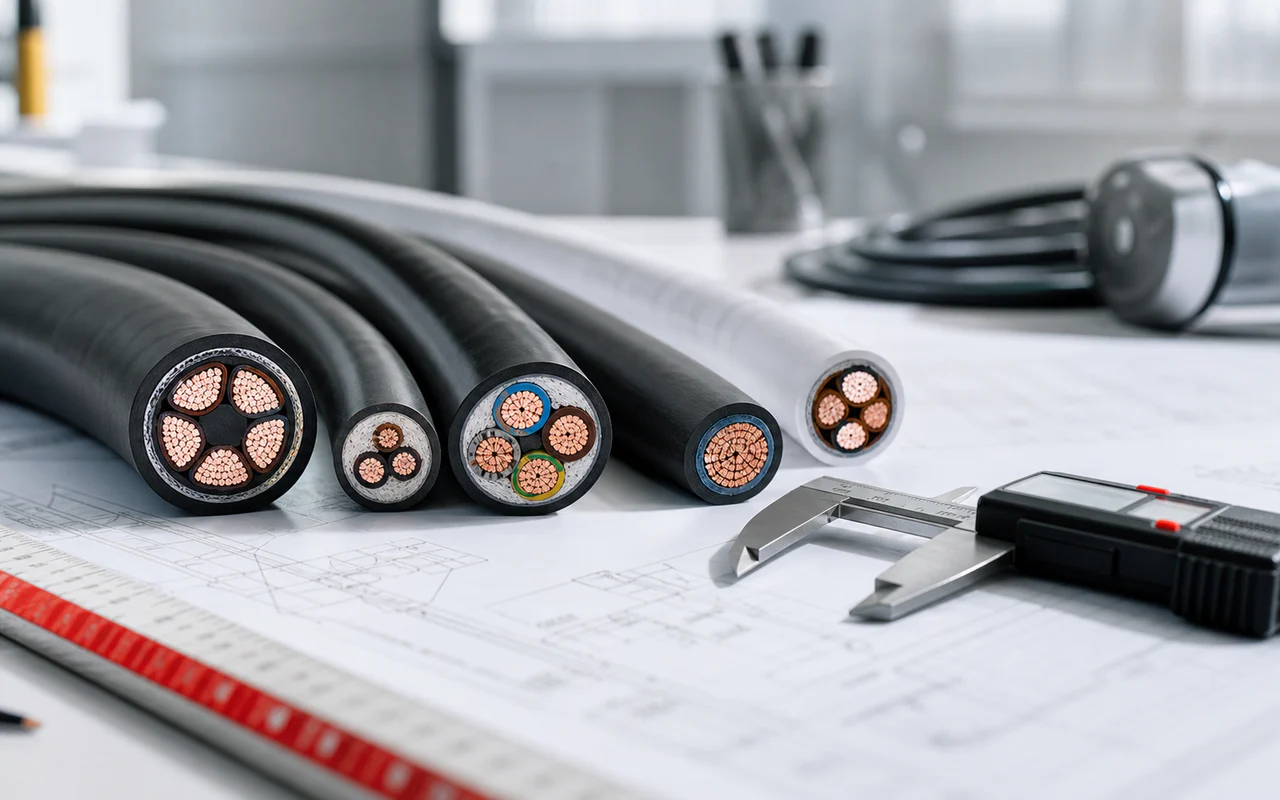
When a procurement team begins a low-voltage cable search, the product family is only the starting point. A family groups codes that share a general application area, but it does not describe a single deliverable item. The actual technical decision is made at the level of the individual product code, not at the family level, because a family page is built for orientation and comparison, not for specification.
Codes sitting inside one family can differ from each other in conductor construction, overall size, the standard reference attached to them, or the document record available for that code. Two codes under the same family name are not interchangeable by default. The practical approach is to use the family page to narrow the search to a short list, then move to each candidate product page before any quotation step begins.
Match the Table to the Document
Once a candidate code has been identified, the technical table on that product page becomes the primary reference for reviewing its construction. This table is where conductor detail, insulation type, sheath type, and related construction parameters are listed for that specific code, and it should be treated as the working reference during comparison, ahead of any narrative description found elsewhere on the site.
A data sheet, a certificate, or a declaration of performance is only useful if it is tied to the same code under review, or to a scope that is explicitly stated on that record. A document written to describe a family in general terms does not substitute for a code-level record. Before a document is attached to an order or a specification, procurement should confirm it references the exact code, not a broader family description.
Comparing Construction Data Across Candidates
When several codes remain on a short list, a structured comparison keeps the review manageable. Conductor material and conductor count are a first axis, since they affect current-carrying behavior and physical handling on site. Insulation type and sheath type form a second axis, since they determine how a code behaves in a given installation environment, and these fields are exactly what the technical table is built to present in a code-specific format.
Voltage rating framing is a third axis worth checking deliberately, because it is stated per code and is part of how a construction is classified. Reviewing these three axes side by side across candidate codes, rather than reading one code at a time in isolation, is what turns a family-level shortlist into a defensible, code-level choice before any commercial step is taken.
Where a Standard Reference Actually Applies
A standard reference is often visible at the family level, on a family page or in a general product description, and this can create the impression that it applies uniformly to every code inside that family. In practice, a standard reference is a code-level attribute, not a family-level guarantee, and it should be checked against the specific code rather than assumed from the family it belongs to.
Before a standard reference is written into a technical specification, a purchase order, or an internal approval record, it needs to be verified at the code the order will actually use. Carrying a standard reference forward from the family description into a formal document, without this check, is a common source of mismatch between what was specified and what was actually supplied.
Ordering Mistakes That Repeat
A recurring mistake in cable procurement is preparing a quotation or a purchase order directly from a family-level description, without opening the individual product page to confirm construction detail at code level. This shortcut can work when requirements are broad, but it becomes a risk as soon as a project specification calls for a particular construction, size, or document record that the family description does not itemize.
A second mistake is assuming that two similarly named codes share the same document record simply because their names look alike; naming similarity is not a substitute for checking the table. A third is carrying over a specification written for an earlier project into a new one without re-checking the current table, since a record that was valid for one project's requirement is not automatically valid for another.
Conclusion
A family page is a starting point for narrowing a low-voltage cable search, not a specification. The code-level technical table, matched to a document record for that same code, is the actual basis for a procurement decision and should be confirmed before any order is placed.